Review
Japanese cuisine is the expression of the culinary art developed in Japan. One of the main ingredients is rice, but pasta, fish, and vegetables are also popular, usually seasoned with various local spices.
In the Japanese Restaurant meat is often absent from its traditional cuisine, but you will find it in some foreign dishes such as tonkatsu. The most popular dishes are sushi, sashimi, but also ramen, udon, and soba, as well as tofu and natto. Drinks include sake and green tea and there is a good variety of desserts.
There is no concept of a conventional menu in a Japanese Restaurant with a first course, a second course and dessert, in general, all foods are brought to the table at the same time and eaten in no defined order, according to the preferences of each of diners. It is known to be one of the most balanced and healthiest cuisines in the world, which would explain an important part of Japanese longevity: the extensive use of fresh fish, vegetables, roots, and green tea also makes it ideal for fighting various forms of cancer.
Now you can enjoy your favorite Japanese Restaurant directly from your mobile phone, just one click away. With this application you can order your food at home or reserve a table, you can download it for free in Google Play Store and App Store.
This application tells you if there is one near you, choose between the different options you have to order your food and the entire menu. Its use is very easy, you just have to install it on your device and start using it.
To order food in a Japanese Restaurant you will have to have an account in it, the first time you enter, it will ask you to enter an email and password to register. Once inside your account you will have to indicate your address manually using the geolocation system of the app itself, if there is one nearby it will allow you to order at home, on the contrary, if the restaurant cannot provide this service at home, you will find this option disabled.
From all their menu you can choose everything you want, you have all the dishes that you would have in the physical Japanese Restaurant, and you just have to add to your cart to place the order. Once you have chosen everything you want to eat, you just have to go and confirm the purchase. The application guarantees security in the payment and gives you the possibility to pay in different ways: with a credit card, with PayPal or even in some places it allows you to pay once it is delivered.
You can also use it to reserve a table at a Japanese Restaurant, without having to call or wait for one to be prepared when you arrive. In the Reserve table option they will guide you so that you can do it, you just have to indicate the date and time, and with a section if you want to add any other indication.
In 2013 it is inserted between the oral and intangible heritage of humanity by UNESCO. We recommend some of their dishes that you cannot stop trying:
Anmitsu is a Japanese dessert made up of small cubes of translucent white jelly called agar, obtained from red algae. They are mixed with water or fruit juice and served in a bowl along with a sweet azuki bean jelly called anko (from which anmitsu "an" is derived), boiled peas, and mixed fruit. The sweet black syrup called mitsu (which completes the name anmitsu) is poured over the jelly at the end.
Chawan mushi is a cream made with eggs and dashi broth. In Japanese restaurants, as soon as you sit down, water is served, sometimes directly from a jar. This water, called ohiya, is free. Some tourists are surprised, especially when cold water is served in winter. However, if you are lucky, you can get tea instead of ice water.
Oshibori is a wet towel that is used to clean the hands and mouth before and after a meal. It can be supplied cold or hot, depending on the season. According to tradition, soy sauce has been made with three simple ingredients: soy, salt and water, fermented for months with special molds.
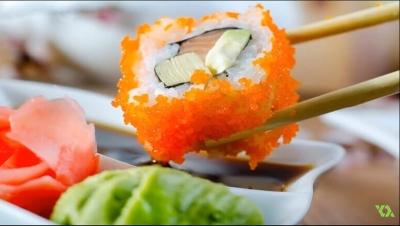
Today, soy sauce is generally produced in a few days with hydrolyzed soy. But should it be combined with Sushi? Yes, as long as it is not placed next to the rice, but next to the fish, to avoid suffocating the flavor of the latter.
If you want to try the best that Japan has to offer, you don't have to book a table at an expensive restaurant. You can enjoy cooking at home through the app! It is very well organized and the recipes are very tasty.